Short answer: Match the impeller to the liquid: vortex impellers for water with soft solids and fibres, open channel impellers for efficient drainage, and cutting or grinder impellers for raw sewage with rags and wipes. Size the sump so the pump starts no more than 10–15 times per hour, and use an automatic float switch for unattended operation.
Define the liquid
"Sewage" covers everything from slightly dirty rainwater to raw toilet waste with rags. Write down what enters the pit: grey water, black water, sand and silt, fibres, kitchen fats or industrial effluent. The answer decides the impeller and material.
Impeller types
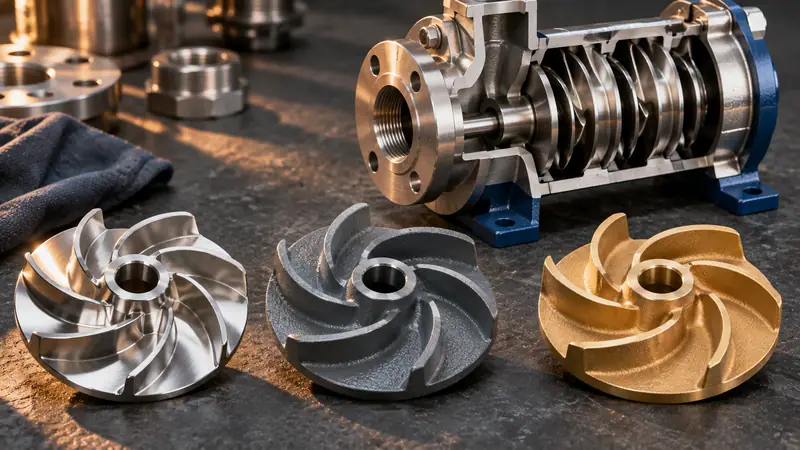
- Vortex (recessed) impellers sit back from the flow, creating a whirlpool that moves solids without them passing through the vanes. Very clog-resistant; slightly lower efficiency. Our V-series stainless pumps use this design.
- Open channel impellers give higher efficiency for drainage water with small solids.
- Cutting impellers and grinders shred rags and wipes. The WQD10 cutting pump is built for this duty.
Flow and head
Estimate the incoming flow — for a house, a peak of around 1–2 L/s; for a building, sum the fixture units. The pump should exceed the peak inflow. Head is the vertical lift from the pump to the discharge point plus friction in the rising main; keep velocity in the pipe above about 0.7 m/s so solids stay in suspension.
Sump design and float switches
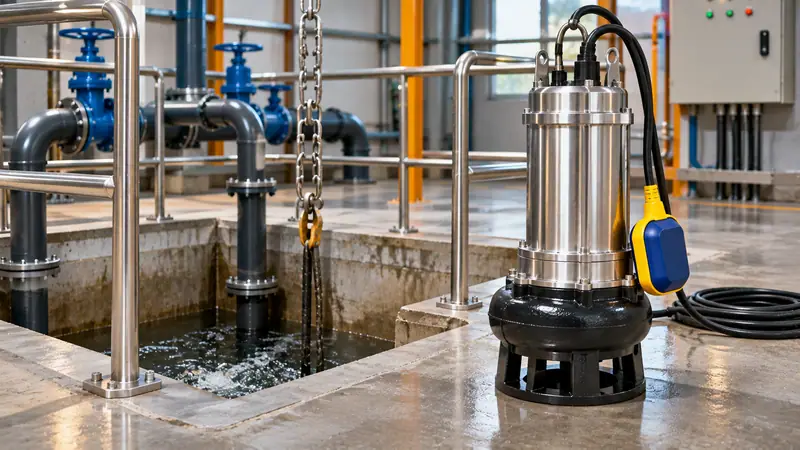
The sump must hold enough volume between start and stop levels to limit starts to 10–15 per hour, protecting the motor. A pump with a built-in float switch, such as the V1100Q or V750AF, simplifies installation. For critical sites, add a high-level alarm float and consider a duty/standby pair.
Materials
Cast iron housings handle domestic sewage economically. Stainless steel housings resist corrosive effluents and are lighter to handle. In all cases look for a double mechanical seal with an oil chamber, which prevents liquid reaching the motor.
Installation tips
- Stand the pump on a firm base so it does not suck up sediment from the pit floor.
- Fit a check valve and an isolation valve on the discharge.
- Drill a small anti-airlock hole in the discharge pipe below the check valve.
- Use a lifting chain or rope, never the power cable.
Frequently asked questions
What solids size can a sewage pump pass?
It depends on the impeller. Vortex pumps commonly pass 25–50 mm solids; open-channel drainage pumps 10–35 mm; grinder pumps macerate solids so they can discharge into small 32–40 mm pipes.
Do I need a stainless steel sewage pump?
Stainless steel is recommended for aggressive effluent, food processing waste and installations where corrosion would be costly. Cast iron is robust and economical for domestic sewage.
How does a float switch control a sewage pump?
A tethered float tilts as the level rises and closes a contact to start the pump; when the level falls the float drops and stops it. The tether length sets the on/off differential.